
We are in the midst of a growing movement to pull back on technology in schools. Across states, districts, and political lines, the response keeps converging: restrict access. Limit/Remove devices. Pause the tool. Ban access. When a reaction is this consistent across so many different contexts, it is not merely partisan. It is systemic, and it reflects concerns that deserve to be taken seriously. Passive consumption. Distraction. Poorly planned technology rollouts with no coherent instructional design behind them, or impactful professional development. Real questions about what unexamined technology use does to a developing reader or thinker. None of those concerns should be dismissed. But taking a concern seriously does not mean the easiest response is the right one. A restriction is easier to announce than a coherent instructional plan for when technology helps, when it does not, and why. Easier is not the same as effective.
Let’s consider reading.
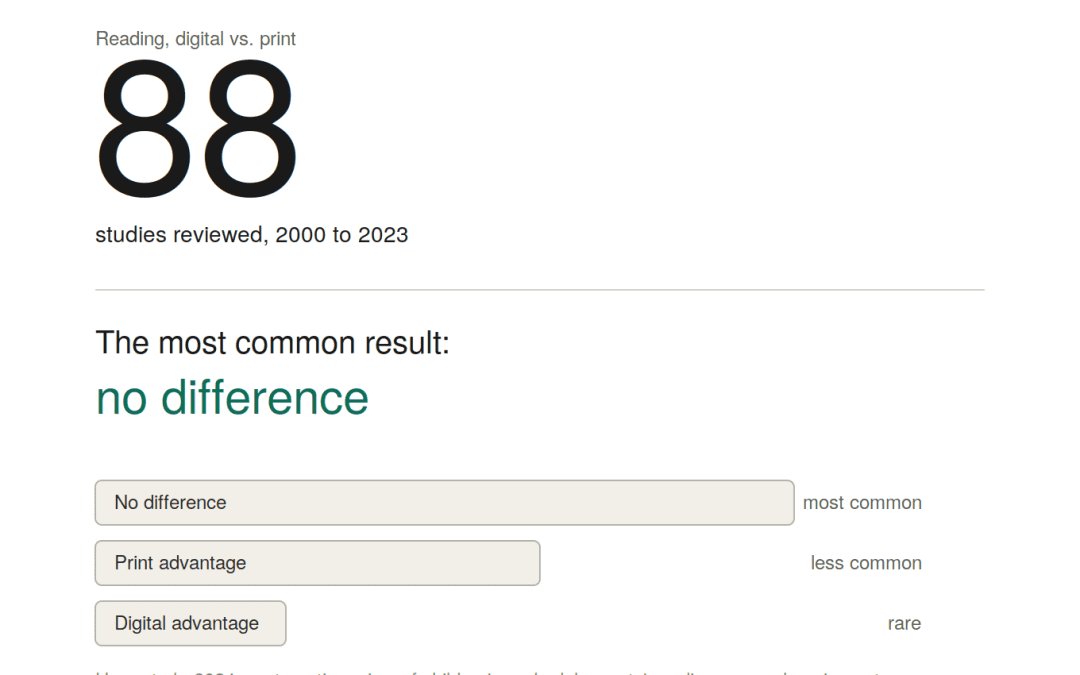
I bring this up because it has come up a number of times recently: the Screen Inferiority Effect. Research on the “Screen Inferiority Effect” has found a small average advantage for print, particularly with informational text and, in some studies, under time pressure. While that finding matters, it is definitely not a verdict against screens. A 2024 review of 88 studies involving children and adolescents found that “no difference” was the most common result. Print advantages appeared more often among older students and with informational text. Another 2024 study found no significant comprehension difference between screen and paper for second- and third-graders when the digital task closely resembled the print task. The picture is more conditional than either side of this debate tends to admit.
Why the effect shows up at all
Where a print advantage does appear, a few explanations recur across the research. Readers tend to bring a faster, more skimming-oriented approach to screens, shaped by years of scrolling feeds and messages, and that habit does not always turn off for a dense paragraph. Digital readers have also been shown to move faster and feel more confident in their comprehension than their actual performance supports, a mismatch between what they think they understood and what they can demonstrate. Some researchers also point to a loss of spatial memory: a reader who recalls an idea sitting in the bottom-left corner of a physical page loses that anchor entirely in an interface built for infinite scroll. None of these are fixed properties of screens. They are tendencies, shaped by habit and by how a digital text is designed and presented, which is exactly why the effect shows up inconsistently across studies rather than every time.
A screen is not a single learning condition
A second grader practicing a targeted reading skill with immediate feedback may benefit from a thoughtfully designed digital environment. A student who needs adjustable text, vocabulary support, or other accessibility features may gain access through that same device. That same student, doing sustained, reflective reading of a longer informational passage, may be better served by paper. Same learner. Different task. Different answer. This is the part binary framing cannot hold. “Screens are harmful” and “screens are essential” are both trying to describe a single variable, the device, when the variable that actually matters is the task being asked of it.
What this means for assessment
Computer-based assessments add another complication. If time pressure, navigation, reader proficiency, and medium all interact, we have to ask whether a score reflects reading comprehension alone, or also how well a student reads and navigates on a screen. That is not a small distinction. Standardized reading assessments are frequently timed, built from short passages, and increasingly delivered digitally, conditions under which a print advantage, when it appears, tends to be most pronounced. A student’s score may be capturing something closer to screen fluency than the underlying skill the test claims to measure. That has consequences for any decision — placement, intervention, promotion — built on the assumption that the score means only one thing.
The harder questions
Technology should not earn its place simply because it is available. But it should not lose its place simply because it is a screen. Before we mandate a device or remove one, we should be asking:
What is the learning purpose?
What does this medium afford, and what does it constrain?
Whose access expands? Whose access shrinks?
What evidence will tell us whether this use has earned its place?
These questions are harder to answer than a policy that simply sets a time limit or a grade-level cutoff. They require looking at instructional design, not just device counts. They require the kind of ongoing, contextual judgment that a blanket rule is specifically built to avoid. Binary thinking can feel decisive. It resolves the discomfort of the moment. But treating every use of a device as interchangeable is not sound instructional design, no more than treating every use of paper as automatically superior.
The issue is not simply how much time students spend on a screen. It is what we ask them to do with that time, and whether that use meaningfully supports learning.